LEARNING · TRAINING · PERFORMANCE
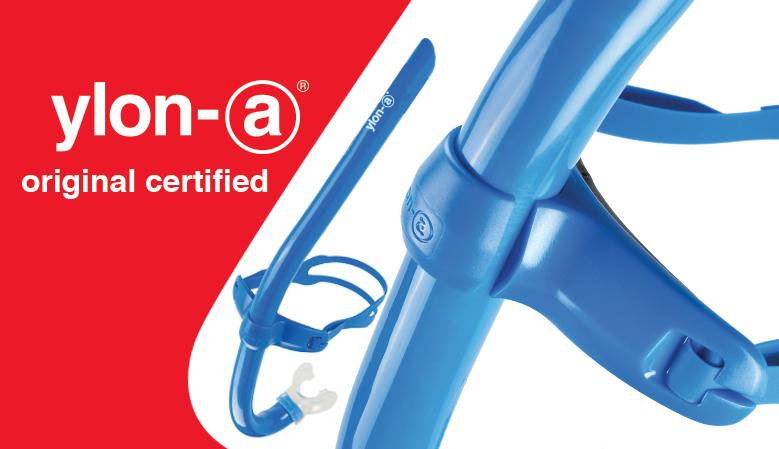
ylon-a® YSTI01 Front Snorkel
from swim schools
to Olympians
How a teaching tool for children became the standard for high‑level training
A front snorkel can meet very different needs depending on level and goals: teaching, technique, physiology.
Read more
How a teaching tool for children became the standard for high‑level training
A front snorkel can meet very different needs depending on level and goals: teaching, technique, physiology.
There is a snorkel with multiple uses, able to meet very different needs depending on the user’s level and objectives. For children, it makes learning to swim easier by removing the breathing constraint, allowing them to focus on the fundamentals of movement. At high level, it becomes a precision tool used by swimmers to refine technique. In freediving, it supports specific training by creating conditions that encourage physiological and mental adaptation.
This snorkel is the original ylon-a® YSTI01 front snorkel.
Initially marketed in a teaching context, it gradually established itself far beyond that, becoming a reference in different training contexts. Its evolution illustrates the transition from an educational tool to a recognised standard, at the crossroads of several disciplines.
The teaching tool — isolate breathing to learn the basics
The YSTI01 was selected in a federation programme to introduce children and structure learning.
Read more
The teaching tool — isolate breathing to learn the basics
The YSTI01 was selected in a federation programme to introduce children and structure learning.
Between 2007 and 2008, the French Swimming Federation and the French Federation of Underwater Studies and Sports launched the “Pass’sport de l’Eau”, a structured programme designed to introduce children to several aquatic disciplines. The goal was not simply to validate a level, but to build a solid technical foundation through tools representative of each practice.
For finswimming, the choice was the front snorkel. A model had to be designed to meet precise criteria: safety (NF EN 1972), teaching effectiveness, and alignment with the technical requirements of FFESSM.
In this context, Théo‑Patrick Fourcade—then a member of the French finswimming and freediving teams, future 2013 World Champion, and founder of ylon‑a®—won the tender with the YSTI01 design. The model became a tool used in swim schools, designed from the outset to match the discipline’s constraints.
Teaching benefits of the ylon-a® YSTI01 front snorkel
In freestyle, learning breathing, propulsion, balance, alignment and coordination at the same time creates a high cognitive load, especially for children. The YSTI01 simplifies this by temporarily removing the breathing constraint.
- Breathing
- Propulsion
- Balance
- Alignment
- Coordination
Freed from the need to turn the head to breathe in, the swimmer can focus on the mechanical fundamentals of the stroke: body position, quality of the catch, stability and timing.
This approach follows a simple principle: isolate variables to facilitate learning. The front snorkel becomes a structuring tool that helps build efficient swimming step by step. The YSTI01 is therefore not just an accessory for children, but a true teaching support, offering a precise answer to a central challenge in learning to swim.
The high‑performance tool — technique and physiology
A design built for individual performance, adopted as a teaching tool, then as a worldwide high‑level standard.
Read more
The high‑performance tool — technique and physiology
A design built for individual performance, adopted as a teaching tool, then as a worldwide high‑level standard.
Originally, the YSTI01 was born from a personal need. Théo‑Patrick Fourcade used it in his own freediving preparation and gradually developed a design aligned with his performance objectives. The work focused in particular on a specific breathing constraint made possible by a reduced inner diameter, creating demanding and targeted training conditions.
This development, initially intended for individual high‑level use, took on another dimension when a tender was launched by the French Swimming Federation and the French Federation of Underwater Studies and Sports. The model was proposed and selected because it matched all requirements: safety, standards compliance, teaching effectiveness, and coherence with finswimming needs.
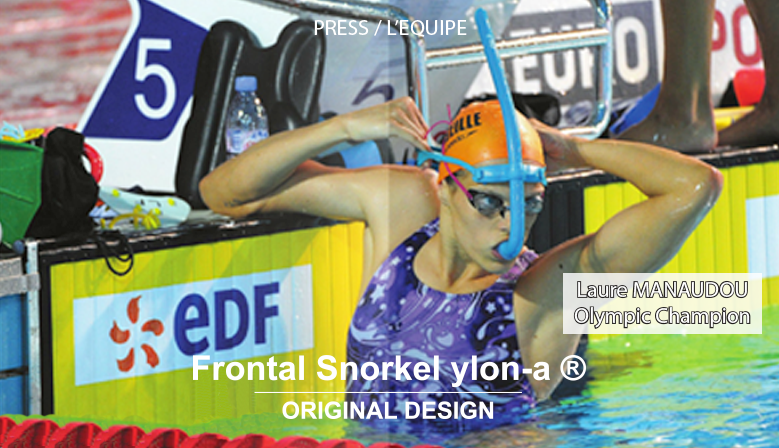
The YSTI01 was deployed in swim schools, where it became a structuring learning tool. Later, it returned to high level by another path. Frédéric Bousquet, French national team swimmer and world record holder, adopted it for his own training and found the qualities that motivated its original design: precision, stability, and the ability to create a demanding technical work environment.
The loop was complete. A snorkel designed for individual performance became a teaching reference tool, then returned to its initial role in high‑level preparation—eventually becoming a worldwide standard.
One essential point must be clarified: the 18 mm inner diameter was not invented by Théo‑Patrick Fourcade. It had long been used in finswimming to meet specific technical demands. The YSTI01’s innovation lies in the overall design that makes this level of constraint accessible in another context. The goal was to bring high‑level standards into a tool usable in swim schools.
Design work therefore focused on several decisive points: eliminating vibrations that could disrupt swimming, optimising hydrodynamics, ensuring material quality for stability and durability, and complying with NF EN 1972.
The YSTI01 is the result of a transfer of demands: a design from high level, adapted for broad distribution without compromising technical quality. This allows a learning swimmer to evolve with the same fundamental constraints as a trained athlete—precisely the continuity that explains its adoption by elite swimmers.
Once integrated into high‑level training, the YSTI01 reveals two distinct uses. On one hand, it enables precise technical work by neutralising breathing, freeing the swimmer’s attention to focus on stroke quality, catch precision, hand path and body‑line stability. On the other, it enables physiological work under constraint by limiting respiratory flow, creating controlled hypercapnia that develops tolerance to physiological stress, cardio‑respiratory efficiency and the ability to sustain intense effort.
The decisive detail — the impact of head position
Head position determines alignment, force transmission and efficiency.
Read more
The decisive detail — the impact of head position
Head position determines alignment, force transmission and efficiency.
The YSTI01 does more than stabilise breathing. Its design guides the swimmer towards a specific position, especially of the head, by creating a constraint that helps organise the body along a more precise axis.
The correct position is simple and observable: the gaze is oriented forward, the chin is slightly tucked, and the neck aligns with the back. This creates head engagement, felt as a slight “double chin” sensation—an indicator of active alignment. When this is set, the head, spine and the rest of the body organise along the same axis.
- Gaze oriented forward
- Chin slightly tucked
- Neck aligned with the back
Efficiency in swimming relies on force transmission. When a swimmer applies pressure to the water, the reaction only produces optimal movement if it travels through an aligned body. If the head breaks alignment, part of the energy dissipates, the trajectory degrades, resistances increase and efficiency drops. Conversely, a correctly positioned head enables direct transmission of forces forward.
A common observation: without a snorkel, children often keep the head naturally aligned, but with a front snorkel, some tend to lift the head to prevent water from entering the tube.
This is where coaching becomes essential. With a simple cue—slightly tuck the chin and engage the neck—the position changes. The head is no longer just “in line”; it is actively aligned with the rest of the body. The snorkel stops being a constraint and becomes a structuring tool.
Once alignment is set, several elements adjust naturally: the spine follows a stable line, rotations organise around a coherent axis, propulsion becomes more efficient and energy is better transmitted. A seemingly minor adjustment thus produces a global effect on stroke quality.
The YSTI01 also helps reveal and structure this position. It does not replace the cue, but amplifies its effects, acting as a mechanical guide that helps swimmers internalise a fundamental principle of efficiency.
YSTI01 vs YSTA01 — which one to choose?
For swimming, YSTI01 is the reference choice. For intensive/competition finswimming, YSTA01 is recommended.
Read more
YSTI01 vs YSTA01 — which one to choose?
For swimming, YSTI01 is the reference choice. For intensive/competition finswimming, YSTA01 is recommended.
The choice of snorkel depends primarily on the practice context and goals.
For swimming, the YSTI01 is the reference choice. It is suited to learning, technical work and physiological progression. Its versatility makes it usable at every level, from beginners to advanced swimmers. It has become the default model precisely because it covers all swimming‑related needs. Today it is the worldwide reference.
For finswimming, the YSTA01 is recommended when you are in a competitive setting or under high‑intensity effort conditions. It meets the physiological demands of the discipline by ensuring sufficient oxygen flow to sustain maximum performance.
Both models share essential features, including NF EN 1972 compliance and a 48 cm length that matches CMAS requirements.
To see these uses in practice, videos show how Olympic swimmers use the YSTI01 in training, illustrating the principles described:
Watch videos of Olympic swimmers talking about the ylon-a® YSTI01
Conclusion
The YSTI01 is both accessible and demanding, adopted from swim schools to elite athletes.
Read more
Conclusion
The YSTI01 is both accessible and demanding, adopted from swim schools to elite athletes.
Designed originally for individual performance, it found a teaching application before returning to high‑level sport and becoming a worldwide standard.
Created between 2006 and 2007, commercialised in 2008, protected and certified, it embodies a high‑level design, sustained technical demands over time, compliance with safety standards (NF EN 1972), and adoption by both institutions and elite athletes worldwide.
FAQ — Frequently asked questions
Read more
FAQ — Frequently asked questions
Are front snorkels allowed in swimming competition?
No. No breathing device is allowed in official competition (FINA / World Aquatics). The front snorkel is exclusively a training tool: it allows you to work on elements that are impossible to isolate in competition conditions.
Which front snorkel should you choose to start?
YSTI01 is the recommended model. Its 18 mm inner diameter enables progressive adaptation while providing enough constraint to structure learning. It is used as a reference in clubs and swim schools because it supports both initial learning and progression toward a higher level.
Can children use a front snorkel?
Yes, provided use is supervised. For children under 1.50 m, supervision by a coach is recommended. The front snorkel is widely used in federation programmes.
What is the difference between YSTI01 and YSTA01?
YSTI01, with an 18 mm inner diameter, is oriented toward swimming and technical work. YSTA01, with a 22 mm inner diameter, is designed for finswimming and maximum performance. Both models comply with the 48 cm CMAS regulatory length.
Why is the ylon-a® snorkel cheaper than some copies?
Because it is sold direct, without intermediaries. The price does not reflect lower quality, but a different distribution structure. It is also the only model certified NF EN 1972, implying high safety and manufacturing requirements.
What is the NF EN 1972 standard?
It is the European safety standard. It guarantees material quality, mechanical resistance and safe use. The ylon-a® snorkel is currently the only front snorkel certified to this standard, validated by INPP.
Can the snorkel be cut for finswimming competition?
Yes, if necessary. However, ylon-a® models already comply with the 48 cm maximum length imposed by CMAS, making modification generally unnecessary.